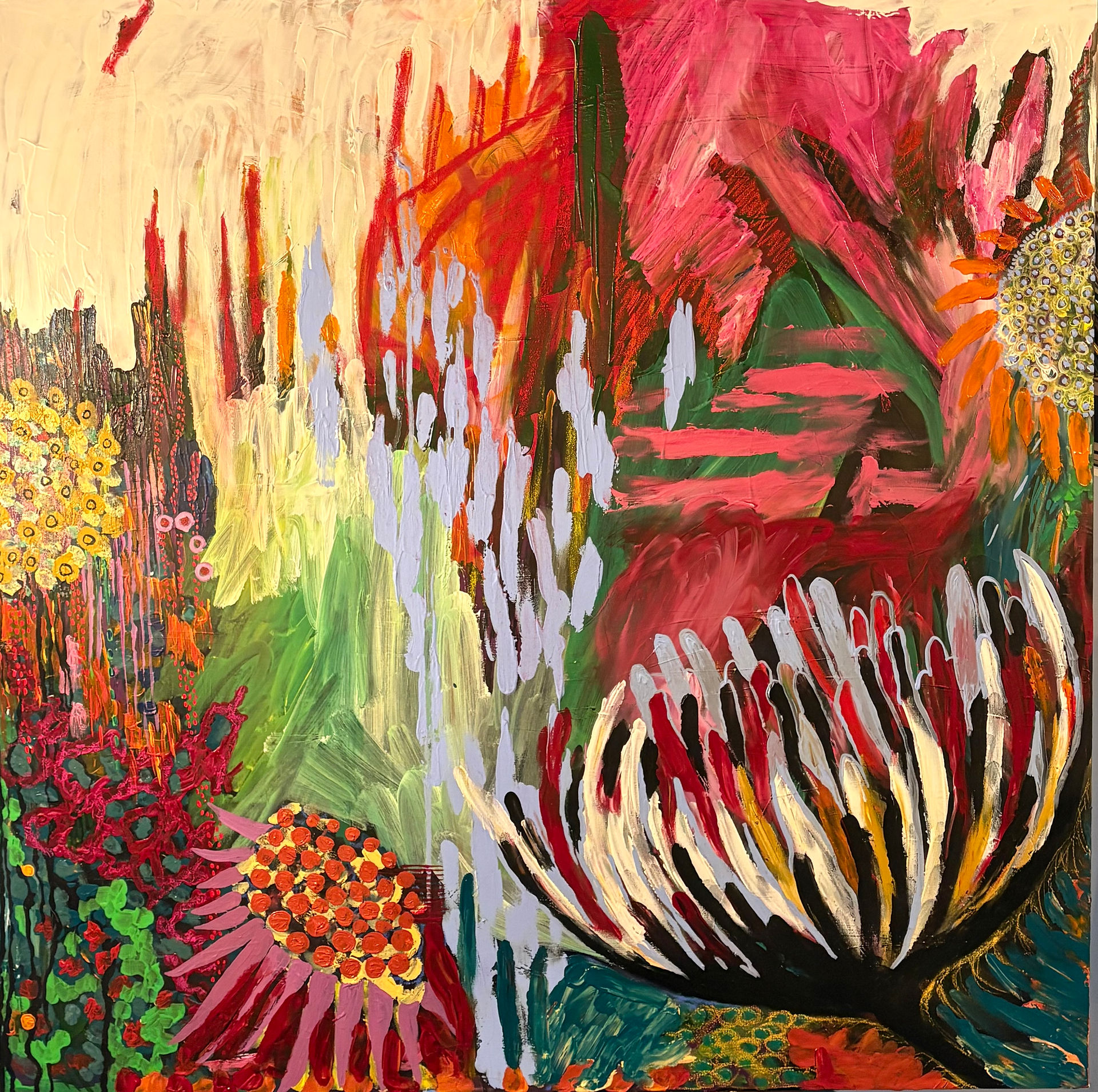

Why Your Hardest Paintings Are the Ones Worth Finishing


There's a painting in most artists' studios — or in their head, waiting to be started — that they keep circling back to and walking away from. Not because they lack the skill. Because something about it matters too much, and mattering too much feels dangerous. This is about that painting, and why it's pointing exactly where you need to go.
The painting that stops you is the one trying to show you something
We call it creative resistance, and we talk about it like it's the enemy. Like the frozen feeling in front of the canvas — or the notebook, the loom, the clay — is something to fight through or talk yourself out of. But I've spent more than twenty-five years in studios, and I've come to believe something different.
Resistance doesn't show up where the work doesn't matter. It shows up at the edges of what's real.
The paintings that stop me — and if you're reading this, probably the ones that stop you — are almost never the technically difficult ones. They're the emotionally true ones. The ones where the thing you're trying to put on the canvas is something you actually feel. Something that came from a dream, or a loss, or a stretch of time you haven't fully understood yet. Something that matters.
That's what the resistance is telling you. Not that you lack the skill. Not that you should put down the brush. It's telling you that you're standing at the edge of something honest, and honest work always feels dangerous before it feels right.
The hardest paintings are almost always the most honest ones. And the most honest ones are the ones worth finishing.
Twenty-five years in, and I still hit the wall

So, picture this: my first-ever guitar-painting gig was on a vintage '68 or '69 Telecaster, valued at a cool $17,000. No pressure, right? Messing it up was about as appealing as a root canal. The client wanted the Disraeli Gears album cover by Cream on it. The catch? The guitar’s shape and pickguard were about as cooperative as a cat in a bath. I churned out mock-up after mock-up, trying to make it work. The client and I spent hours in meetings as the work progressed through the approval process. In this art tug-of-war, would it be the Cream members' portraits or the psychedelic artwork that had to take a backseat? Less is more often holds true.
I had to take breaks, leave the house, and even shed a few tears just to keep my sanity intact. Quitting wasn’t in my vocabulary because I was determined to nail this, keep my business afloat, and avoid turning a pricey guitar into an expensive paperweight. I kept telling myself, "This is my Sistine Chapel!" And yes, I know Leonardo probably wanted to throw in the towel a few times too. But hey, pushing through has always been worth it. My greatest masterpieces come from my relentless refusal to give up. It's either a superpower or a curse, depending on which side of the paintbrush you’re standing.
What I can tell you is that it still happens. After all these years — the exhibitions, the completed commissions, the bodies of work I'm proud of — I still find myself in the studio, standing in front of a canvas I've been avoiding, wondering if I'm the right person to make this particular thing. Know you always are. I've learned to recognize that feeling now. It used to make me step away. These days, it makes me stay because it means something fantastic is about to happen. Trust yourself.
The messy middle has a name (and it's not failure)
In trauma-informed coaching work, there's a concept called the threshold — the liminal space between what was and what's becoming. It's the place that feels like falling, because you've left the familiar ground and haven't landed anywhere new yet. It's uncomfortable in a way that doesn't resolve quickly. And it's the most fertile creative territory there is. This holds true for creative arts coaching, too. Fear is the fertilizer of potential or failure. Choose potential.
When a painting stalls—when you hit that wall—you haven't failed. You've reached a pivotal moment. The work is demanding something from you that you aren't ready to offer yet. It might be a truth you've been avoiding, a vulnerability you've been shielding, or something you've been denying. Dig deep, and you'll uncover it. Perhaps the painting needs to become something different from what you envisioned, and you're clinging to the original plan. Letting go of what isn't working is crucial in both mental health and the creative arts. They are more interconnected than you might realize.
Research on creative risk consistently shows that the artists who produce the most resonant work aren't the ones who feel less fear. They're the ones who've developed a relationship with it. Don't fight it; bring fear along for the ride and use it as fuel for your creations. The fear that says something real is happening here. Stuckness, reframed: not evidence against you, but evidence of proximity. You are close to something true. That's why it's hard.
Four things to do when you can't make yourself finish it

These are the practices I return to, in my own studio and with the artists I coach. They're not magic. They're ways to settle the nervous system enough so the creative mind can do what it actually knows how to do.
1. Breathwork before the brush
When we're creatively stuck, we're usually also physiologically activated — shallow breath, tension in the shoulders, a low-grade sense of threat. Breathwork isn't a wellness trend; it's a direct tool for shifting the nervous system state. Before you pick up the brush on a hard day, spend three to five minutes with conscious connected breathing: longer exhale than inhale, no pause between the two. Let the body settle before you ask the mind to be brave.
2. Work in small time containers
"I'll work on this painting" is an enormous ask. "I'll spend fifteen minutes with this painting" is manageable
. The brain is much more willing to show up for something bounded. Set a timer. Sit with the work for that contained time and nothing more. Give yourself permission to stop when it ends. Often you won't want to. But knowing you can is what lets you start.
3. Switch media temporarily
Sometimes a painting stalls because the medium itself has become part of the stuck feeling. If you're an oil painter, try a quick study in watercolor, or charcoal, or pastel. The shift in medium releases you from the gravity of the stuck piece — you can't be precious about a fifteen-minute charcoal sketch. It loosens something. And often what you discover in that looser space is the exact thing the stalled painting needed.
4. Talk to the painting, not about it
This one feels strange until it doesn't. Sit in front of the painting and speak to it out loud, or write to it in a journal. Ask it what it wants. Ask it what it's afraid of. Ask it what it already knows that you haven't admitted yet. You're not waiting for a literal answer — you're interrupting the analytical loop that's keeping you stuck, and creating space for something more instinctive to surface. The painting often "answers" in the next brushstroke you weren't planning to make.
What happens on the other side

It isn't always a finished painting. I want to be honest about that.
Sometimes you push through the wall and what you find is a different painting than the one you started — one that surprised you, that went somewhere you didn't plan, that looks nothing like your original sketch. Sometimes you push through and find that this particular piece was a passage into the next one, and its job was to take you somewhere, not to become something you hang on a wall.
What always changes is you. Your relationship with the work, and with yourself as a maker. Every hard painting you finish — every threshold you cross — leaves you with something that can't be learned any other way. A kind of knowledge that lives in the body, not the mind. A little more trust that you can show up for the difficult things.
That trust is what makes the next hard painting possible. And the one after that.
If you're standing at that edge right now — with a painting, a series, or a whole creative practice — I work with artists one-on-one to move through exactly this kind of moment. Discovery sessions are open. You can find out more and book a conversation at ninarischart.com.


Comments